





Leading with curiosity: How to grow through empowering others
Today on “The Building Code,” Zach and Charley are sitting down with Mark Williams, founder of Mark D. Williams Custom Homes and host of “The Curious Builder” podcast. For nearly two decades, Mark’s home-building experience has been fueled by his endless curiosity and ability to adapt, learn and grow. He also takes pride in surrounding himself with dedicated craftspeople who share his mission to bring homeowners joy while creating their dream home.
Listen to the full episode to hear more about why company leaders should be more curious and know when to let others take the lead.
Why did you start “The Curious Builder” podcast, and how has it contributed to the success of your business?
“I started ‘The Curious Builder’ podcast, and I had no idea what I was going to do with it. I just knew I wanted to tell other builders’ stories. I wanted to ask them questions in a real setting. I really enjoy just talking to people and asking them about their journey. Half of it was to shine a spotlight on the companies you’re interviewing and through curiosity, asking them the questions, finding out what makes them tick. And the second part is, I want to learn two to four business ideas that they’ve already experienced that I can apply to my own business. I just feel like there’s so much learning out there to be had. We can learn so much from each other, and it’s like hyper networking. It’s amazing how often you have a question that maybe you’re dealing with right now.”
What is a quality that you think makes for a good leader?
“I’ve used the analogy in building that someone might be the best builder on the planet. He might know every code, every cool detail, every piece of knowledge known to man. Does he know more than 100 people? No, probably not. So, the point is I tell my clients, ‘I want to empower the people around me. I don’t want them to be afraid to ask questions, and I also want them to know that they have a vote at the table.’ If my cabinet guy, I’m going to say his name is Rich. ‘Rich, you build for a lot of other builders, too. This is what I’m trying to achieve. Do you see a different way to do it?’ And he’ll say, ‘Yes.’ I think being a leader is empowering other people. Sometimes being a leader is stepping aside and letting someone else be the leader.”
Links and more
Check out “The Curious Builder,” and subscribe wherever you listen to your podcasts.
With a dwindling workforce continuing to affect the construction industry, business owners are turning to technology to increase efficiency. Download our free guide for tips on how to combat the labor shortage and increase productivity by 50%.
Related content:
Tune in to the last episode to hear from APB’s Russ Stephens about the notable trends that emerged from the 2024 State of Residential Construction Industry report.
Subscribe here, and never miss an episode.
Got podcast topic suggestions? Reach out to us at podcast@buildertrend.com.
The Better Way, a podcast by Buildertrend:
Looking to add construction tech to your daily processes? On the newest season of “The Better Way, a podcast by Buildertrend,” you’ll get best practices for implementing software and getting your team on board from other industry pros and our experts. Subscribe and stream today wherever you listen to podcasts.
Follow us on social:
Listen to “The Building Code” on YouTube! And be sure to head over to Facebook to join The Building Code Crew fan page for discussions with fellow listeners.
Zach Wojtowicz:
What’s up, everybody? Welcome to “The Building Code.” I’m Zach Wojtowicz.
Charley Burtwistle:
And I’m Charley Burtwistle.
Zach Wojtowicz:
Mr. Burtwistle, it’s almost springtime.
Charley Burtwistle:
Yeah, I mean, close. It is snowing outside right now, so spring is not yet in my mind, but fingers crossed and hopefully it continues to snow while we’re in here. We get snowed in. We get to spend a whole weekend together.
Zach Wojtowicz:
See, that’s the fun thing about Nebraska. It could snow in May.
Charley Burtwistle:
Yeah.
Zach Wojtowicz:
You just never know what’s going to happen. We’re always keeping you on your toes.
Charley Burtwistle:
Always keeps you on your toes. You always have to be curious about what the weather is going to be.
Zach Wojtowicz:
This man.
Charley Burtwistle:
You like that, Zach?
Zach Wojtowicz:
I do. Yeah.
Charley Burtwistle:
I’ve been thinking about that one for a full week now. Always have to be curious. On that note, today we have the host of “The Curious Builder,” one of the best construction podcasts in the universe, and he is on with us today to talk more about his podcast, about his journey to where he is at today, and just how to be a curious leader. I think that’s going to be the official name of the title is curiosity and leadership. So, I was very, very excited. Zach, who do we have?
Zach Wojtowicz:
Yeah. Well, Mark is going to be in here to talk a little bit about his business as well. And I’m also excited, I always like having podcasts on because they can size us up a little bit and give us some advice.
Charley Burtwistle:
Yeah, we’ve had a couple, Nick Schiffer, a few episodes ago. Mark today. These are big names in the construction podcast space, so I’m nervous.
Zach Wojtowicz:
Do you think marketing teams get a hint? We’re actually interviewing your replacements while …
Charley Burtwistle:
Sadistic of them, but yeah, it could be.
Zach Wojtowicz:
Yeah. All right, well, we’ll let the listeners decide. Let’s get Mark in here.
Mark, welcome to “The Building Code.” It’s your first time, and I can already tell you it will not be your last. How are you?
Mark Williams:
I’m great. Thanks for having me on. Let’s get this party started.
Zach Wojtowicz:
That’s right. What an intro. What an intro. Let’s get this party started. I don’t even know where to go from there. Before we go down too far, tell us a little about yourself, tell us about your company, your story. We always like to get a feel for who you are and what you do.
Mark Williams:
Well, I’m coming up on two decades in building. My 20-year anniversary is this spring. I grew up a third generation builder. I knew building was the one thing I did not want to do because who wants to do what their grandpa, uncles, and dad does? So they all retired, no plan for the wildcard. Then I was one year in sales, came out of college with a communication and business degree. I’m like, “Man, how hard can it be? My parents are builders and designers. I mean, I should give it a shot, right? They’ve been retired.” So, I started building a house and I was like, “This is amazing.” Sold my Jetta up, bought a truck because that’s what you do as a builder, went and got my building license, and it’s been 20 years in the bank, and I’m still wanting to know why my career counselor didn’t talk me out of this a long time ago.
Zach Wojtowicz:
I actually love the idea of a Jetta being like how you roll up on the job site.
Charley Burtwistle:
Yeah, right?
Zach Wojtowicz:
I think we should normalize that in construction. Are trucks even useful? I mean …
Mark Williams:
They are if you do stuff. It’s funny because my dad was called the briefcase builder back in the ’80s and ’90s. I didn’t know what that was. I would essentially now probably seemed as a marketing person who happens to build homes. I tell my clients, and it keeps on working, “The calluses on my hands are not from working on your house. They’re from lifting weights, playing tennis, or doing something other stupid.” And I always tell my clients, “If you see me working on your house, call the project manager, call the site manager. I’ve ruined something.” So, I’ll be the first to tell you I am not a building expert. I am very curious. I’ll ask a billion questions.
But really my interest has probably started more with design and just kind of more of the can-do attitude than the know-how attitude. And even today, I tell my clients all the time, “That’s a great question. I don’t know the answer to it. Let me get back to you.” I think one of your questions I think that you were even prepping me for was the nature of our podcast is called “The Curious Builder.” I’m probably an insatiably curious person and I think that’s to my core even from a young person. So, I’m not afraid to ask questions, and I’m not afraid to look stupid, and I do it pretty regularly, so I’ve kind of come numb to it.
Zach Wojtowicz:
At some point it becomes a skill. You’re just like, “Wow, you’re really good at just being curious and getting yourself into situations and always getting out of it,” right?
Mark Williams:
Think about how much building has changed in the last decade, much less 20 years. But even now with the advances in technology and building sciences. I mean, there’s so much happening. Even if you knew everything. If you’re not self-educating, if you’re not asking the question why and what can I do better, it doesn’t matter how knowledgeable you are. You’re already becoming prehistoric. I mean, I think you constantly have to surround yourself with people that are going to help inform you and make you better. I mean, look around the room. Hopefully you’re surrounding yourself with a lot smarter people than you. Otherwise, you need to go hire somebody.
Charley Burtwistle:
Well, in the current room I’m in with Zach, I don’t know how much that works, but no …
Zach Wojtowicz:
Sometimes you’re also stuck with people. I don’t know what to tell you.
Mark Williams:
Is the bar pretty low, Charley?
Charley Burtwistle:
Yeah, insanely low.
Zach Wojtowicz:
Wow. Where’s the curiosity? Really? Can you ask a question at least to verify it?
Mark Williams:
No, I’m just taking him at face value. He seems like he’s just dealing straight, but you know what? That’s fine. Sometimes you got to work with some amoebas.
Zach Wojtowicz:
Yeah. Sometimes it’s obvious. Why I ask questions?
Charley Burtwistle:
I do think, all jokes aside, you did steal my segue there into your podcast. You saw exactly where I was going. I can tell you’ve done this before.
Zach Wojtowicz:
A podcast veteran in his own right.
Charley Burtwistle:
Yeah, exactly. He knew where we were going.
Zach Wojtowicz:
He could see it.
Charley Burtwistle:
Before we get to the meat and the potatoes, I believe this episode title is going to be Curiosity and Leadership. You’re self-branded and well renowned because of your podcast, “The Curious Builder,” so I wanted to quick chance to plug that and talk a little bit about what you talk about on the podcast. Why is it called “The Curious Builder?” And then I’ll beat you to it. We’ll segue into why curiosity and leadership is so important after that.
Mark Williams:
Way to pull an Audible there, Charley. So, I would say I was on a podcast before I even knew what a podcast was. So, I’m a huge audiobook guy. I do a lot of long-distance running, and so, I listen to a lot of book tapes, but I’ve never liked series of things because just of a compulsive nature. I don’t like to be in something and not end it. So, Brad Leavitt actually invited me to come on the AFT podcast, and I was halfway through it and just having a ball. I’m like, “People do this for a job? I didn’t even know this was a thing. This is amazing.”
And honestly, 30 days later, I started “The Curious Builder” podcast. I just didn’t really have a target market. I had no idea what I was going to do with it. I just knew I wanted to tell other builders stories. I wanted to ask them questions in a real setting. Probably 90% of my interviews so far have been in person, but as we’re, obviously, a national podcast, I mean anywhere somebody listens to it I guess. But we’re starting to now, basically, every other week do something outside the state of Minnesota.
But I really enjoyed just talking to people and asking them about their journey and the whole idea of it was … Half of it was shine a spotlight on the companies that you are interviewing and just through curiosity, asking them the questions, finding out what makes them tick. And then the second hard part is I want to learn two to four business ideas that they’ve already experienced that I can apply to my own business. I just feel like there’s so much learning out there to be had, but we can learn so much from each other and it’s like hyper networking. It’s one hour with wherever the other person wants to go. And it’s amazing how often you have a question that maybe you’re dealing with right now.
Actually, I had a podcast earlier this morning, and I had a question about margin and markup, and she was giving a speech on profitability. And I totally derailed my own podcast because we spent half of the podcast just talking about her subject matter. I was just really interested because I’m also dealing with it right now trying to figure it out. That was kind of the backbone of why I started it and what I hope it to become. And now it’s sort of evolved into something … We’re now weekly as of about eight months ago. And part of it is I like to do live events. I’ve now locally done four … No, I’ve done two live events, and here in ’24, I’m planning on doing four live events where basically we will speak to an audience of 60 to 100 people plus, and we’re going to do a podcast interview in front of an audience. And it’s also a networking opportunity as well as kind of a little bit of showmanship and entertainment. I’ve really enjoyed that.
Zach Wojtowicz:
Oh, go ahead, Charley.
Charley Burtwistle:
I was just going to say, I think you hit the nail on the head just how valuable doing podcasts are, which are really just a cheat code to, as you said, networking, meeting people, learning. I was actually just having this conversation with my boss yesterday. He was like, “Hey, I’m going to miss the meeting tomorrow. I have to do the podcast.” Zach and I do have real jobs here outside of just podcasting. And he’s like, “Do you find that valuable? Do you want to keep doing it?” And I was like, “I love it. The best part of my week is the two hours.” One, because I get to hang out with Zach, and two, because you’re right, you just learn so much, and it doesn’t matter the industry. You learn what big people tick, you learn how they solve problems. You nailed it absolutely perfectly. Podcasts are the perfect Trojan horse to asking and learning and stealing ideas from other people. So, yeah, I love where your head is at and the way that you’re viewing your journey through the podcast world.
Mark Williams:
I think, I like what you said there, the cheat code because, ultimately, you’re taking what you’re dealing with. It’s like free therapy, whether it’s marriage.
Charley Burtwistle:
Literally.
Mark Williams:
Or working through your subcontractors. I mean, I can’t tell you how helpful it is honestly in any relationship. Well, I’ve always been a big talker. I do have a lot to say, but sometimes I can’t stop myself from asking questions. When I told my wife that I was going to start a podcast, her first thing, and I love her dearly, and I know she loves me, she said, “You know you have to listen to people, right?”
Zach Wojtowicz:
You could be a shock jock radio and just be talking into the ether. You could have been the Skip Bayless of building.
Mark Williams:
But you know what’s funny? You know what? I can’t do that, Zach, that monologue.
Zach Wojtowicz:
No, really?
Mark Williams:
I need someone to play off of and to ask questions and go back and forth. I greatly admire … Tyler Grace does his midweek check-in on “The Modern Craftsman.” Shout out to him. I don’t know how he’s able to just kind of monologue on one thing. That’s not really my skillset. So, I’m better off kind of working off of somebody. So, I need kind of a dueling partner, if you will, someone to interact with. Those are the ones that are the most enjoyable. But the last part of it was is I will say that, in my opinion, I guess I’ll ask my wife tonight at dinner, I feel like I’ve gotten to be a better listener by practicing. But would you guys … I don’t know much about your own personalities, but don’t you think that the podcast helps you even kind of direct your own thoughts sometimes in terms you have to give … especially on a zoom call like this, you have to give pauses, which I’m not giving you, to let the other person speak.
Zach Wojtowicz:
Exactly. I actually have two things with that. One, my wife has been like, “Stop podcasting me.” She’ll be like, “You’re trying to interview me, and I’m not one of your guests.” And then the second thing is I find myself thinking about the podcast in moments to kind of position, how would I ask this on the podcast in this work meeting to be more professional? I can’t react. I have to try and put it into an environment. So it’s interesting how doing it has shaped even my habits or behaviors.
Mark Williams:
Do you find that it’s odd that everyone’s like, “Oh, that’s so cool. Podcast is so new and so cutting edge.” And in my mind I’m like, “Haven’t they been doing radio interviews for 200 years?”
Zach Wojtowicz:
Yeah.
Mark Williams:
When was the radio invented? I feel like this is a Fireside Chat with FDR into the nation. Do you guys find that, too? People say how new it is and you’re like, “Well, it’s actually a pretty old technology.”
Zach Wojtowicz:
Yeah, I’ve had a lot of people be like, “You’re famous.” I’m like, “I can assure you I am not famous.” But as a bit of a historian fan myself, I definitely think about how, yeah, people have just been talking in bars for years. This is not really all that big of a deal. They just slapped a marketing brand behind it. Shout out to Apple for turning it into something. I think about that. Did they mean for it to become what it is? Or was it just one of those things like, “I don’t know, people talking and recording it. Why would anyone listen?” And then here we are.
Charley Burtwistle:
Here we are.
Zach Wojtowicz:
Yeah, but great thought. Anyway, let’s talk a little bit about …
Charley Burtwistle:
Question number two. Yeah. The first one took 10 minutes here, so we’re rolling …
Zach Wojtowicz:
Hey, we set expectations. We know. We know, right, Mark?
Mark Williams:
Everyone just times one of these episodes times two. So, if you’re a 20 minute episode, a lot of people do x2 and listen to it fast. I will say I speak pretty fast. It’s going to be pretty hard to speed me up to x4 and finish this episode in five minutes. You know what I’m saying?
Zach Wojtowicz:
That’s a good challenge. I’ll do that when it drops.
Mark Williams:
Sounds like a gerbil. It’s not a good sound.
Zach Wojtowicz:
We brought you on to talk a little bit about your leadership. I can just tell you’re a fun person. You’re super positive. I’m curious on your perspective on the traits that you look for in leaders and how that has affected not only your company but just your general way that you conduct yourself out in the world.
Mark Williams:
That’s a great question. It’s interesting as being now … Sometimes you think … I don’t know that much about your backstory. Do you guys own your own companies? Or I assume you guys are in construction. Do you have building companies or remodeling?
Zach Wojtowicz:
No, we are …
Charley Burtwistle:
Definitely not. We work here at Buildertrend, internal employees.
Mark Williams:
You work at Buildertrend.
Zach Wojtowicz:
Yep.
Mark Williams:
The reason I bring it up, and maybe this is a founder thing, is I don’t really think of myself as a leader. And I don’t know … Actually this would be a great question I should ask someone else on the podcast because sometimes … I’ve often wondered when people think … Does anyone ever think that they’re a subject matter expert? And maybe is that kind of the secret is you never really think you’re an expert. And they talk about imposter syndrome, and you’re talking about a subject it. But I’ve built for 20 years and all joking aside, yeah, I know what I’m doing. But that being said, I don’t feel like I’m an expert and yet if you’ve done something for 20 years, you probably hit the 10,000 hour rule, right, Malcolm Gladwell wrote about it in his book and among others? And it’s like, well, you are an expert.
So, I wonder if as a leader, how often do leaders actually think that they’re a leader? I hired a fractional CEO recently to help kind of put some systems in place. I realized that one of my weaknesses was systems. You can probably tell about my personality organization and really staying in confined boxes is hard for me. I’m more of a colorful personality, and so, it’s like how can you build a house when you have to follow a blueprint if you have a lot of energy? Well, that’s because someone has the blueprint the architects have driven. They’ve given me the confines to stay within and then I can use my energy to push it through the process. Where I’m going with this leadership question is sometimes I wonder, am I a good leader, and what does it take to be a good leader? I think sometimes you become a leader without knowing it. Then just recently, this summer, I’ve sort of paused and thought, I might not be a good leader. I don’t actually know the answer to that question for myself personally.
Zach Wojtowicz:
That’s a really good perspective though. I’m, obviously, not all that veteran in the space of leadership, but I think one thing I do a lot is I look at other leaders that are remembered of them, and I look at the traits and a lot of them definitely had … You know it when you see it, right? A lot of them were people follow them because of what they were doing and by their very nature became leaders because they were trying to accomplish something. So, I think you’re right that no one goes out and … If you’re planting a flag in the ground and says, “I’m a leader,” people are going to be like, “That’s not how that works. Leaders lead.”
I talked to my own team about this quite a bit. There’s a difference between a manager and a leader, and a lot of people can learn how to manage, but leaders are something that … I think it does take a mindset, but it doesn’t necessarily reflect actions. A lot of the best leaders I look up to are very genuine. They’re who they are, and then people follow them because they observe their behaviors and the way they actually and the way that they answer questions or the way that they just are, that they say, “That person is someone that I want to be a part of.” Right?
Mark Williams:
I think for me, just giving me a little more time to think about it, I think for me being a leader is really empowering people around you. I guess now as I’m reframing the question in my own mind, I think I do that a lot actually now that I think about it. Because for instance, I always tell my clients, “You don’t want a…” I use the analogy of, “If one person tells everyone else what to do all the time, they’re an amazing artist.” I don’t know that much about singing, but I know Pavarotti is very famous. So, that guy can carry a note like nobody but you give me 100 people in a choir singing, you won’t even hear Pavarotti.
I’ve used that analogy in building that someone might be the best builder on the planet. He might know every code, every cool detail, every piece of knowledge known to man. Great. Does he know more than 100 people, or she? No, probably not. In fact, there’s no way. So, the point is I tell my clients, “I want to empower the people around me. I don’t want them to be afraid to ask questions, and I also want them to know that they have a vote at the table.” If my cabinet guy, who I trust, and I’ve worked with him for over a decade, not only has earned the trust, but I’m going to give people the trust right off the bat actually.
I’m going to say his name is Rich. “Rich, you build for a lot of other builders, too. This is what I’m trying to do. This is what I’m trying to achieve. Do you see a different way to do it?” And he’ll say, “Yes.” I think being a leader is empowering other people to have leadership, and sometimes being a leader is stepping aside and letting someone else be the leader. I think that’s what being a good leader is.
Charley Burtwistle:
Yeah, I think that’s a great answer. I think to your comment earlier is you want to surround yourself with people that are “smarter” than you or that you trust or that you can lean on. I think that’s a great analogy with the choir as well, too. I think that’s the type of people that I’m drawn to. If I’m thinking of myself as a follower, those are the type of people that I want to lead is not someone that’s going to tell me exactly what to do, but someone that’s going to come to me and be like, “How should we do this? What would you do?” You’re almost making leaders out of followers. That’s just an interesting thought, and I think that’s a really cool way to frame it.
Mark Williams:
I think, too, Charley, you just tapped something that triggered something for me is I think if you are … Oh man, I just lost it. Can you repeat what you said? It just triggered for me and now I lost it.
Charley Burtwistle:
Making leaders out of followers, empowering, asking their opinion.
Mark Williams:
Yeah, I think it was along the lines of empowering it. Now, I should have written it down because I was like, “Aha,” but I had to let you finish your sentence. The problems with interrupting people. It’ll come back to me. But basically, I guess I was just triggering the line of this empowerment of other people. Oh, I know. Smart. You mentioned the word smart. Actually, if I was to characterize things that I look for in other people, I don’t even think smart takes my top seven. I would much rather have follow through, work ethic, enthusiasm, joy. I’m just coming off the top of my cuff here. I’m sure we could come up with more than smart.
Zach Wojtowicz:
Curiosity?
Mark Williams:
Yeah, curiosity would be a good one. Ask why. But honestly, follow through. It is probably my number … And this is why I prioritize communication almost over any other thing because if you can communicate well … And I’m not perfect. I’m just telling you that I value it. I really appreciate people that close the loop on things. And sometimes you can be perceived as being overly abundant on that in terms of … It’s like a text message. Even your interpersonal skills. Again, going back to husband and wife, “Did you pick up the kids on the way home?” “Yes.” Just closing the loop on stuff. To building. “Did you get the permit? Did you pay for it?” I mean, just simple stuff. Honestly, most business things are not that difficult. You just have to see it all the way through.
Zach Wojtowicz:
That is kind of the secret underlying thing of a lot of processes is it’s a way to try and build that communication, so that there is consistency, that there is a loop. But if you find people who just go out of their way to already communicate, a lot of that stuff is … SOPs are protection, but you want to find people that just have that innate, “Oh, I just know being a good teammate, being a really positive influence on my workplace with peers, it’s about communication.” And it’s just amazing how many problems get solved just by doing those little things. Totally agree.
Mark Williams:
I also think going back … That’s such a great question, about being a leader. I think another huge trait of really successful leaders are people that become super fans of their people. And where I’m going with that is, again, I often think I have three little kids and I think of course you can love your kids. Of course, they come in … I have a seven, five, and a three-year-old, and each one of them bring in a piece of artwork that my wife will probably throw away when they’re sleeping and they’ll say, “Dad, do you like it?” And you’re like, “Yeah, that’s amazing. It’s so great.” And where I’m going with this is your enthusiasm and generosity of spirit towards somebody else empowers them to not only share, but also be creative. I’m thinking of the space of an architect, of my interior designers, of my trim carpenter, my painters, getting excited about what they’re excited about, but being genuine about it.
You can’t fake it. If you fake it, it’s a hollow tin can. You really have to be real. I think that’s going back to the curiosity thing. When you truly care and are curious about other people and what makes them tick, sometimes it’s not always good. Sometimes you’re like, “Man, what makes that person tick? They’re weird.” I think even as we interview clients, we’re not a fit for everyone and I’m not a fit for everyone, and that’s okay. It took me a long time to understand, to really just own your own personality and your own brand and to realize that I don’t have to chase every build lead. I don’t have to chase every remodel lead. You know what? We are good enough as we are, and if we’re a good fit for you, we would love to work with you. And it can be just that simple.
Charley Burtwistle:
I think you mentioned learning on the way and the realizations that you’ve learned recently. I think this may be an interesting question because I’m kind of skipping ahead. The next question we have has some of your accolades, 16 major awards, 2021 Minnesota Builder of the Year, two decades in construction, 231 happy clients. I’m curious, I love your perspective and where you’re at now, but take me back 10 years. As you were coming up, what have been some of the major, not necessarily milestones, but learnings for you of, “Okay, this, I need to change the way I’m doing this,” or, “Oh, I need to double down on this”? Because talking to you now, you’re very professional, you’re very polished. I love the conversation that we’re having. Maybe it’s a leap of faith. Maybe you’ve always been this way, but I’m going to assume you’ve learned some lessons along the way.
Mark Williams:
I think life teaches you a lot of these lessons. We don’t have enough time to talk about all of them. I’m thinking two or three pretty major milestones, but maybe I’ll start with the end in mind in sense that for me personally … The homes that I build now are a million and a half to $5 million. The first home I ever built was like 500,000. I think not losing perspective, and I probably have lost perspective before, and this is where having a family around you that were in building remind you, is just that the same family that moves into a $100,000 house, a $200,000 house, a $10 million house, it’s a home. It’s where they’re going to raise their family and we’re providing an essential need.
Now, yes, I’m working on first world problems, and that’s a whole separate podcast, but I guess the point is not losing sight that we’re building for families, and it’s where they’re going to live and raise and have memories. I think that is what is so appealing to our tradesmen and our partners as well, is who doesn’t have a memory of their home, good, bad, or indifferent? You have a memory of your home. And to be a part of that journey, I’m getting goosebumps just talking about it. I need to remind myself of how valuable that is and really make sure that the client experience is being justified through the whole process to really honor that.
Zach Wojtowicz:
Yeah, it’s critical.
Mark Williams:
And to answer the second part of your question, which is just really, what are some main things? I mean, in the beginning, you just don’t know what you don’t know. I mean, I’m 23 years old, I had no idea what I was doing. But in some ways, that’s also a benefit. I give major props to people who are 35, three kids. I just interviewed someone, she had four kids. Her builder got sick, and she stepped in, became the GC, finished their house, and then became a builder. That is baller. That is so …
Charley Burtwistle:
That’s sweet. Wow.
Mark Williams:
Shout out to Meghan Billings from Meg & Co. up in Twin Falls, Idaho. That is a killer story.
Zach Wojtowicz:
Way to go, Meg. Friend of the pod.
Charley Burtwistle:
Friend of the pod.
Mark Williams:
Yeah, she’s a huge friend. I think these different milestones … So, for me, my clients sort of took me to where I am today. What I mean by that is we built high quality homes 20 years ago. What that means is different than what it is today, style, architecture, things like that. But we were always several steps ahead of what our peers were at that range. Then a client would come along and they’d say, “Well, we’ve seen the work that you’ve done here. Could you do it at a different scale?” Yes, I could. So, you kind of go along that line.
I think the other big one was 2008. I am not a great spec home builder because I know all the good stuff and I always put it in, so I’m not very good at making things really inexpensive. I’m just really good at getting you excited about the expensive stuff and then buying it. So, unfortunately, when it’s my money and 2008 hits, that’s the only house in my career I’ve ever lost money on. But I’ve often said that I got my master’s degree in business and building in half the time and four times the cost. I feel like those four years somehow surviving 2009, ’10, ’11, ’12, and then coming out of it, a lot of people were gone. So, at that time in my age, I just happened to be the right place at the right time, and a lot of competition got taken out because they were overextended.
Well, I just didn’t have a lot to lose because I didn’t have any money. So, if you don’t have a lot to lose, you can sort of survive those low times. That was being kind of willing to do whatever it took. I even went and worked for another builder for a short time while I was still doing my homes just to project manage. I’m like, “Well, man, if I can get $20,000, $30,000 and project manage another builder’s home, I’m not above that.” So, I did that, too. Then we kind of took a quantum leap up. We had one client that kind of took us above a million, and at that point then we never really looked back. We kind of kept going with that peer group.
And then I would say just recently, the last two years … The last year has been actually very difficult for a variety of reasons that we won’t get into on this podcast. It won’t be long enough. But the point of it is I’m really hopeful for the future. I feel like we kind of hit a wall, and I feel like now we’re on our way going through that wall. So, you hear about that and I’ve asked other people about their journey, and you get into these little stepping stones. I feel like they talk about shattering the glass ceiling. I hardly know what that means except Charlie and the Wonka factory, a glass elevator shooting through the roof. But the point is I feel like we’ve hit that wall, and now we’re kind of going through it in a different direction. So, that has me really excited.
Zach Wojtowicz:
Mark, we’re up against the time, so we can’t …
Mark Williams:
Shocking. Shocking.
Zach Wojtowicz:
Yeah. I know. It just flew by, so I’m just giving you our warning. But I want to talk a little bit more about what kind of topics do you discuss on your podcast for those that we send them off and they’re like, “Wow, I want more Mark Williams,” what kind of things are you talking about with your guests?
Mark Williams:
We’re talking about really the origin story of their home or their home building career. We kind of interview everyone, we’ll interview builders, interior designers, architects, anyone that is even remotely associated with the building and construction industry and is kind of spreading out to different avenues. And then half of it is highlighting them, and then the other half is just business practices. My hope is that you learn a lot about them as a company and then can apply their business stories to your own life and your own career and then apply them so that you can kind of level up without having to go through some of those glass ceilings yourself.
Zach Wojtowicz:
I love it. Well, consider two new subscribers for sure. We’re going to be checking it out. I know it.
Charley Burtwistle:
It sounds like Zach doesn’t already subscribe …
Zach Wojtowicz:
Oh, you know.
Mark Williams:
Peer pressure.
Charley Burtwistle:
Yeah.
Mark Williams:
Kidding.
Charley Burtwistle:
Thank you so much, Mark. This was an awesome interview. We definitely, I can say without a doubt that we will have a part two coming soon. Would love to have you back on again, but really appreciate your time today.
Mark Williams:
Thanks, guys. Good luck in the snowstorm, and thanks for having me on.
Charley Burtwistle:
See you, Mark.
Zach Wojtowicz:
All right. We just had Mark here on “The Building Code.” A whirlwind of information, a deep conversation about curiosity, and I’d like to think I’m a pretty curious person, but man, he outdid me on the curiosity. I have to be honest. I got to step my curiosity game up.
Charley Burtwistle:
Way up.
Zach Wojtowicz:
What was your takeaway?
Charley Burtwistle:
I thought it was really good. I love the range that we have on “The Building Code” of guests that we have. I think I always learn a ton when we get super, super deep into construction processes.
Zach Wojtowicz:
I love Mark just being like, “You guys, obviously, own construction companies.” We’re both like, “Yeah, we can’t even pretend like we … No.”
Charley Burtwistle:
Fun fact, I did two years in high school.
Zach Wojtowicz:
Well …
Charley Burtwistle:
Co-owner of Burtwistle & Son Roofing.
Zach Wojtowicz:
Yes.
Charley Burtwistle:
So, I did …
Zach Wojtowicz:
And your dad. He’s down there.
Charley Burtwistle:
He teaches construction technology.
Zach Wojtowicz:
Talk about in the universe, I’m not even in the same timeline of being able to claim that I can build something. I know construction processes, though, like Mark was talking about. I was like, “I resonate with that. I can help build all day that you need a structure in order to run your business.” So, it’s all good. I thought that was a funny moment for me.
Charley Burtwistle:
Absolutely. But where I was going with that is I love those types of podcasts, but every now and then we have a guest on there that the advice that they give and the way they answer questions is relatable to every industry, every person, and just career and leaders. This is the stuff that fill my bucket and that I love talking about. So, I thought it was a great interview. I wrote down some notes. I’m actually super excited to go back and listen to it again because I feel like there was some great nuggets in there, and definitely a guest that we’re going to have to have on a second time.
Zach Wojtowicz:
Yeah, I think that’s without question. That’s happening whether Mark realizes it or not. So, he’s listening right now, and he’s just already booking. We could get a series going.
Charley Burtwistle:
Yeah, recruiting guests.
Zach Wojtowicz:
Curiosity offshoot of “The Building Code.” I would be down for that collab.
Charley Burtwistle:
Yeah. Well, hopefully the listeners enjoyed it, and they’re going to have to subscribe to not just “The Building Code,” but “The Curious Builder,” too, and hopefully our paths will cross again, and you’ll get a nice little notification on your phone as soon as it happens.
Zach Wojtowicz:
That’s right. Love it. Always about the plan. We will follow up with that someday, I promise. Thank you so much for listening to “The Building Code.” I’m Zach Wojtowicz.
Charley Burtwistle:
And I’m Charley Burtwistle. We’ll see you next time. Peace.
Mark Williams | D. Williams Custom Homes
Places You Can find us




We think you’d also like this

Top 21 must-reads for construction pros
Here’s our list of the top books for construction pros – and we’ve even included a few expert recommendations from some of our top Buildertrend customers.

Adopting a growth mindset in construction
Learn how adopting a growth mindset throughout your company can ensure a successful construction business model, even as new challenges face the industry.
podcast
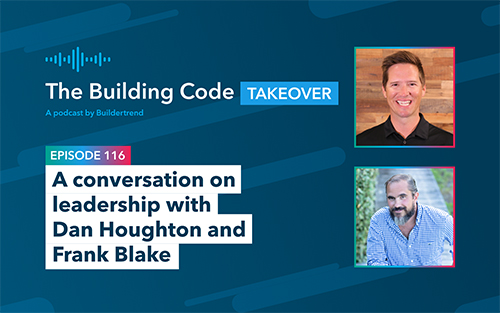
Apr 22, 2021The Building Code Takeover: A conversation on leadership with Dan Houghton and Frank Blake
On this episode, hear about how their experiences have helped their leadership skills evolve and what challenges they’ve had to overcome.